

What Is Reformer Pilates? A Complete Beginner's Guide
Every so often a workout goes from niche to everywhere, and reformer Pilates is the one everyone is talking about right now. Studios are booked out weeks ahead, and for good reason: it builds long, strong muscle, sharpens posture and improves flexibility, all while staying surprisingly gentle on your joints. If you have been curious but slightly intimidated by the sliding carriage and the straps, this guide covers everything you need before your first class.
We will walk through what reformer Pilates actually is, how the machine works, how it differs from the mat version, the benefits you can expect, what a first class really looks like, and exactly what to wear so nothing rides up or catches mid-movement.

What Is Reformer Pilates?
Reformer Pilates is a form of Pilates performed on a machine called a reformer: a sliding carriage that moves along rails against adjustable spring resistance. You push, pull and stabilise the carriage through slow, controlled movements, which builds core strength, flexibility and balance. It is low-impact, endlessly scalable, and suitable for almost everyone, from complete beginners to seasoned athletes.
Pilates itself is a method of controlled movement, breathing and stretching developed by Joseph Pilates in the early twentieth century. The mat version uses your own body weight; the reformer takes the same principles and adds a spring-loaded machine that both supports and challenges you, letting you work through a far greater range of movement with precise, adjustable resistance.
Because the resistance comes from springs rather than heavy weights, reformer Pilates rarely spikes your heart rate the way a run or a HIIT class does. It works instead through slow, deliberate tension, and that is exactly what builds the deep stabilising muscles most other training tends to miss.

How the Reformer Machine Works
The reformer is a frame with a padded carriage that slides back and forth along a set of rails. That carriage is connected to springs whose tension you can adjust, and it is surrounded by the parts you will use to move it:
- A foot bar you press against with your feet or hands.
- Shoulder blocks that keep you in place as the carriage moves.
- A headrest for support.
- A rope-and-pulley system with handles and straps for your arms and legs.
Every exercise comes down to controlling that carriage: pressing it away, drawing it back, or holding it steady. Adding springs increases the load, while using fewer springs lightens it but demands more stability from you. Strength is built on both halves of each movement, the press out and the slow, controlled return, which is a big part of what makes the reformer so effective.
Reformer vs Mat Pilates: What Is the Difference?
Both share the same philosophy of controlled, core-focused movement, so the real question is not which is better but which suits you.
| Reformer Pilates | Mat Pilates | |
|---|---|---|
| Resistance | Adjustable springs on a machine | Your own body weight |
| Intensity | Scalable, often more challenging | Gentler, depends on the exercise |
| Range of motion | Greater, guided by the carriage | Limited to the mat |
| Best for | Progression, variety, targeted resistance | Foundations, convenience, practising anywhere |
| Cost | Studio classes, higher | Low, can be done at home |
In practice, many people do both: mat work to build the foundations and practise at home, reformer sessions to progress and add resistance. If you are deciding where to start, a beginner reformer class is a perfectly good entry point, precisely because the machine guides your form.
The Benefits of Reformer Pilates
Consistent reformer Pilates delivers a specific set of benefits, and they compound the more regularly you practise.
Stronger core and better posture
By targeting the deep stabilising muscles, the pelvic floor, the abdominals and the muscles along the spine, the reformer builds a stable centre that translates into sharper posture and better body awareness in everything else you do.
Improved flexibility and mobility
The spring tension supports you into deeper, safer stretches than you could reach unaided, opening the hips, releasing the shoulders and restoring fluid movement through the spine.
Low-impact, full-body strength
Because the load comes from springs rather than impact, you build genuine strength across the whole body without the joint stress of heavier or higher-impact training, which is part of why it suits so many different people.
Suitable for every level
Every exercise scales up or down with the springs, and most have both a beginner and an advanced version, so there is always room to progress without ever outgrowing the machine.

What to Expect in Your First Class
Booking your first reformer class can feel daunting, but there is very little to worry about; the first session is mostly about learning the machine and finding your form.
What to bring
Studios provide the reformer, so you only need the basics: a water bottle, a small towel, hair ties, and grippy socks, more on those below. Take off any rings or bracelets beforehand so nothing catches on the equipment.
What you will actually do
Expect a slow, form-focused session. You will likely start with footwork on the bar to warm up, then move through exercises that build hip mobility and core control, and possibly some arm work in the straps. Everything is tailored to your level, so you will not be thrown in at the deep end.
Tips for beginners
Book a beginner-specific class or, if your budget allows, a one-to-one to nail your form early. Keep an open mind, expect to feel a little uncoordinated at first, and give yourself permission to get things wrong, because that is simply part of learning the machine.

What to Wear to Reformer Pilates
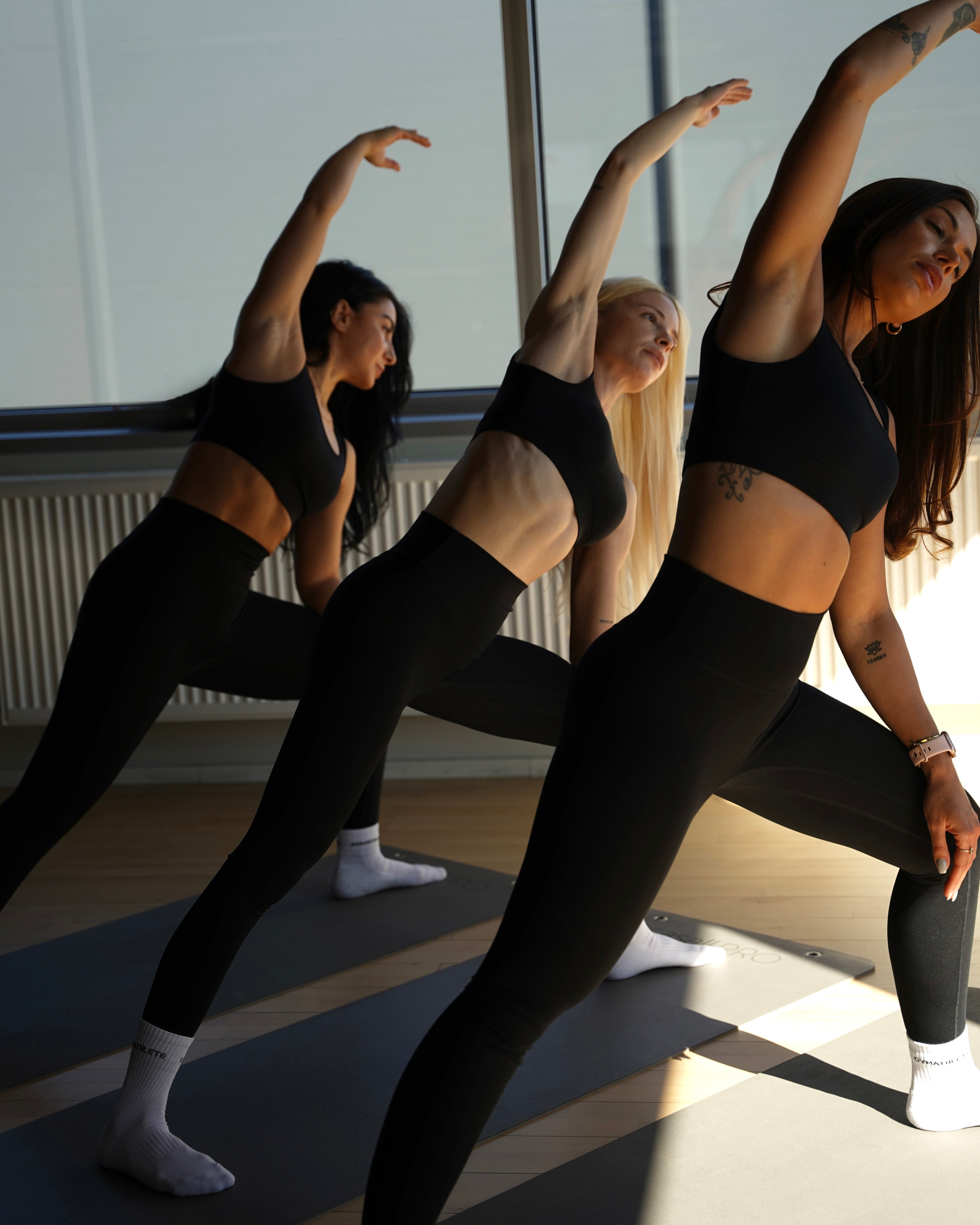
Reformer Pilates has a few specific clothing needs that ordinary gym kit does not always meet, mostly because you spend so much time bending, inverting and moving on a carriage. Here is what actually works.
A close-fitting top
Choose a streamlined tank or a close-fit tee that will not ride up or fall over your face when you tip back or invert. Pair it with a medium-support sports bra, enough to hold you without restricting the deep breathing the practice relies on.
High-rise leggings with real stretch
Your leggings should feel like a second skin: a high, secure waistband that stays put through every movement, genuine four-way stretch, and no zips, buttons or hardware that could catch on the carriage. Opacity matters just as much, since you will be bending and stretching in every direction, so a squat-proof pair is exactly what you want. Our Pulse Leggings tick all of this, and if see-through fabric is a particular worry our guide to leggings that don’t go sheer is worth a read first.
Grippy socks
You do not wear shoes on the reformer, only socks, so a pair of grippy, non-slip socks is essential for traction and safety on the carriage. Most studios sell them if you forget yours.

Dressed for the Carriage
The right leggings make a real difference on the reformer: a waistband that stays put, four-way stretch that moves with you, and coverage you never have to think about. Our Pulse Leggings are built for exactly this kind of controlled, full-range movement.
Life is full of small discomforts. Your activewear shouldn’t be one of them.
How Often Should You Do Reformer Pilates?
For most people, two to four sessions a week is the sweet spot for seeing real progress in strength and flexibility without overdoing it. Beginners do well starting with one to two classes a week and building from there as the body adapts, while more experienced practitioners might train up to four times. As with any training, the same consistency-over-intensity principle applies: showing up regularly matters far more than how hard any single session is. If you want to think through your wider routine, our guide on how often you should go to the gym is a useful companion.

Frequently Asked Questions
Is reformer Pilates good for beginners?
Yes. The machine’s adjustable resistance and support let beginners scale every exercise to their ability, and a beginner class or a one-to-one lesson helps you learn correct form from the very start.
What is the difference between reformer and mat Pilates?
Mat Pilates uses your body weight on a mat, while reformer Pilates uses a spring-loaded machine that adds adjustable resistance and a greater range of movement. Same philosophy, different tools.
Is reformer Pilates harder than yoga?
They challenge you differently. Reformer Pilates focuses on controlled, resistance-based strength and core stability, while yoga leans more on flexibility, balance and mindfulness. Which feels harder depends on your body and your goals.
How often should I do reformer Pilates?
Two to four times a week for steady progress. Beginners can start with one to two classes a week and build up as they get stronger.
Does reformer Pilates help you lose weight?
It builds strength and muscle and supports better body composition, but on its own it is low-impact. Combined with regular movement and a balanced routine, it can be a valuable part of managing your weight.
What do you wear to reformer Pilates?
Close-fitting tops that will not ride up, high-rise leggings with four-way stretch and no hardware, a medium-support sports bra, and grippy non-slip socks.