

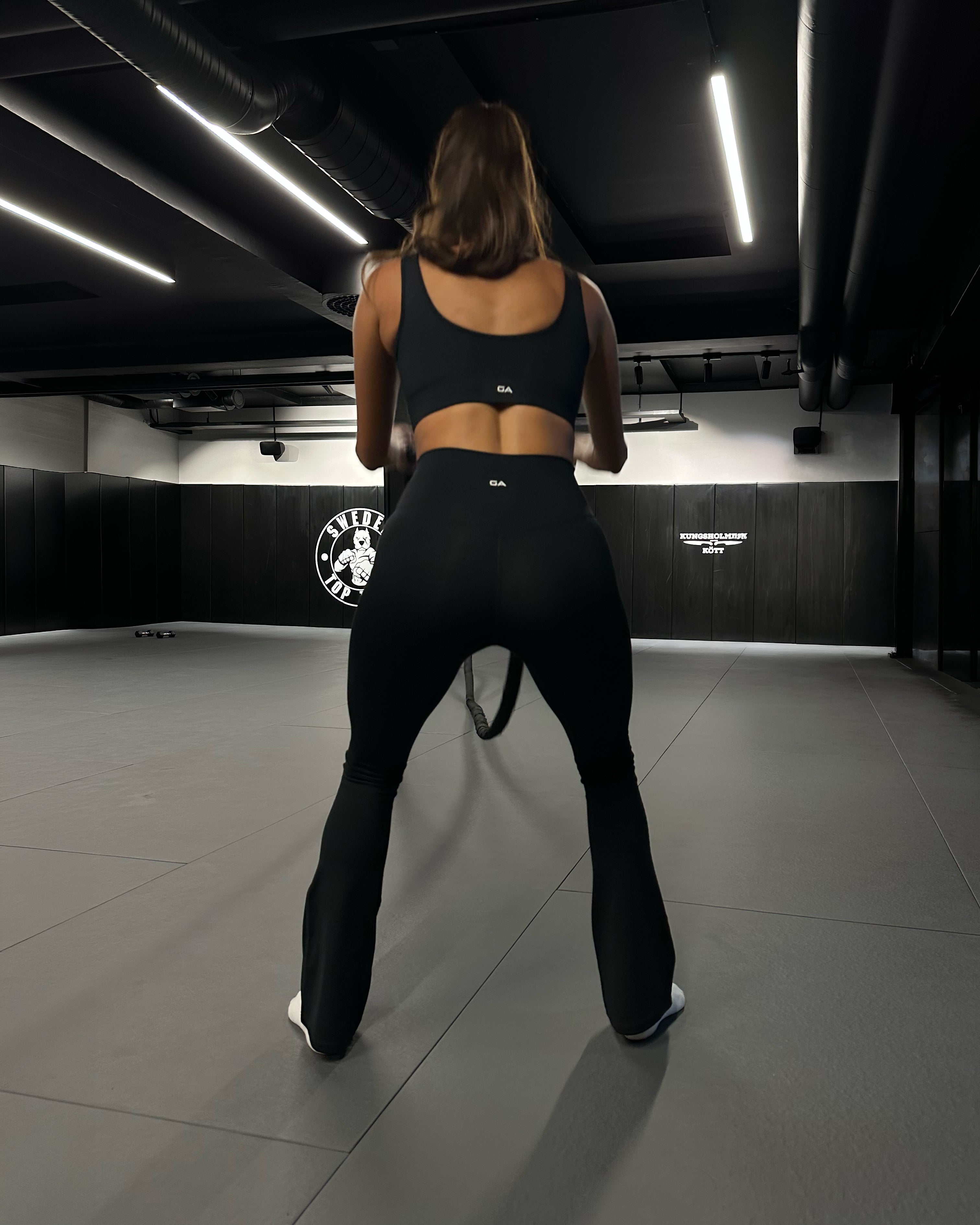
Flared vs Straight-Leg Leggings: Which Should You Choose?
Flared and straight-leg leggings solve two slightly different problems, and choosing between them is less about which is in fashion and more about how you actually wear them. Both can be trained in, both can be worn all day, but the leg shape changes how they look, how they move and which of those two jobs they do best.
This is a straight comparison: what actually separates them, when each one is the better choice, and how to pick the pair you will reach for most.

The Short Answer
Choose flared leggings if you want a longer, more elongating line you can wear from a class straight into the rest of your day. Choose straight-leg if you want a closer, more contained fit that stays out of the way during heavier or faster training. Both should share the same waistband and fabric; only the leg below the knee changes.
The Real Difference
A straight-leg legging holds a close, even width from hip to ankle. It sits near the body the whole way down, which is why it feels contained and disappears under everything. A flared legging is identical through the hip and thigh, then opens gradually below the knee into a wider, longer line that falls over the foot.
That single change does more than it sounds. The flare lengthens the leg visually and adds movement as you walk, which is what makes flared leggings read less like gym kit and more like trousers. The straight-leg keeps everything tucked in, which is what makes it the quieter, more versatile training option. Neither is better; they are tuned for different moments.

When to Choose Flared
Flared leggings are the better choice when the legging has to do more than train. If you go to a class and then run errands, meet someone or simply want to stay in them for the rest of the day, the flare is what lets them pass as everyday wear rather than obvious activewear.
They also suit anyone who wants a longer line. The extended hem draws the eye down and lengthens the leg, which is flattering with trainers and works surprisingly well with a boot or a flat shoe. If most of your leggings live a double life in and out of the gym, flared is probably your default.
When to Choose Straight-Leg
Straight-leg leggings win when you want nothing in the way. For heavier lifting, faster training, running or anything where a wider hem could catch or flap, the close line is simply more practical. It is also the more discreet option under other clothes, and the easier one to layer.
If your leggings are mostly for training and you value a fit that stays exactly where you put it with zero excess fabric, straight-leg is the safer pick. It is the classic for a reason.
Are Flared Leggings Good for the Gym?
Yes, as long as the waistband and fabric are built for training rather than just for looks. The flare itself sits below the knee, so it does not affect squats, hip hinges or how the waistband holds. What matters is everything above the flare: a high, structured waistband that stays put, and a dense knit that does not turn sheer at the bottom of a squat.
Our Pulse Flared Leggings use exactly the same waistband and PulseFlex™ fabric as our standard Pulse Leggings, so the flare is the only thing that changes. If you want the reasoning behind the waistband, our guide on high-waisted leggings that stay up covers it, and the one on leggings that do not go sheer covers the fabric.
| Flared | Straight-leg | |
|---|---|---|
| Best for | Class plus the rest of your day, a longer line | Heavier or faster training, layering |
| Leg line | Opens below the knee, falls over the foot | Close and even from hip to ankle |
| Reads as | Everyday, trouser-like | Contained, classic activewear |
| With shoes | Trainers, flats, boots | Trainers, easy to layer under |
Styling and Height
One practical note on flared leggings: length matters more than with straight-leg. Because the hem is meant to fall over the foot, the right length depends a little on your height and your shoe. With trainers most people want the hem to sit around the middle of the foot; with a flat or a boot, slightly longer looks intentional rather than accidental.
Straight-leg is more forgiving here, since it stops at the ankle and does not have a hem to break in the right place. If you are between the two and unsure, think about your shoes: if you mostly wear trainers and want one pair that does everything, flared is the more interesting choice; if you layer a lot or train hard, straight-leg keeps things simple.
The Pulse Flared Leggings
Same high, structured waistband and PulseFlex™ fabric as the leggings that started it, opened into a clean flare below the knee that lengthens rather than swamps. Made to be worn from a class straight into the rest of your day. See the Pulse Flared Leggings, or the original Pulse Leggings for the straight-leg.
Life is full of small discomforts. Your activewear shouldn’t be one of them.
Frequently Asked Questions
Are flared or straight-leg leggings more flattering?
It depends on what you want. Flared leggings lengthen the leg with a longer line and read more like trousers, while straight-leg gives a close, contained fit. Both are flattering when the waistband and fit are right; the flare simply adds length and movement.
Can you wear flared leggings to the gym?
Yes. The flare sits below the knee and does not affect training, so what matters is the waistband and fabric. A flared pair with a structured high waistband and dense, squat-proof fabric works for training and for wearing afterwards.
What length should flared leggings be?
The hem is meant to fall over the foot, so length depends on your height and shoe. With trainers, aim for the hem around the middle of the foot; with flats or boots, slightly longer looks intentional.
Are straight-leg leggings better for lifting?
For heavier or faster training many people prefer straight-leg because the close line stays out of the way and is easy to layer. Flared leggings are still fine for lifting since the flare is below the knee, but straight-leg is the more contained option.
Do flared and straight-leg leggings fit the same at the waist?
They should. On a well-made pair the waistband, hip and thigh are identical, and only the leg below the knee changes. If two pairs from the same brand fit differently at the waist, that is a construction difference, not a flared-versus-straight one.