

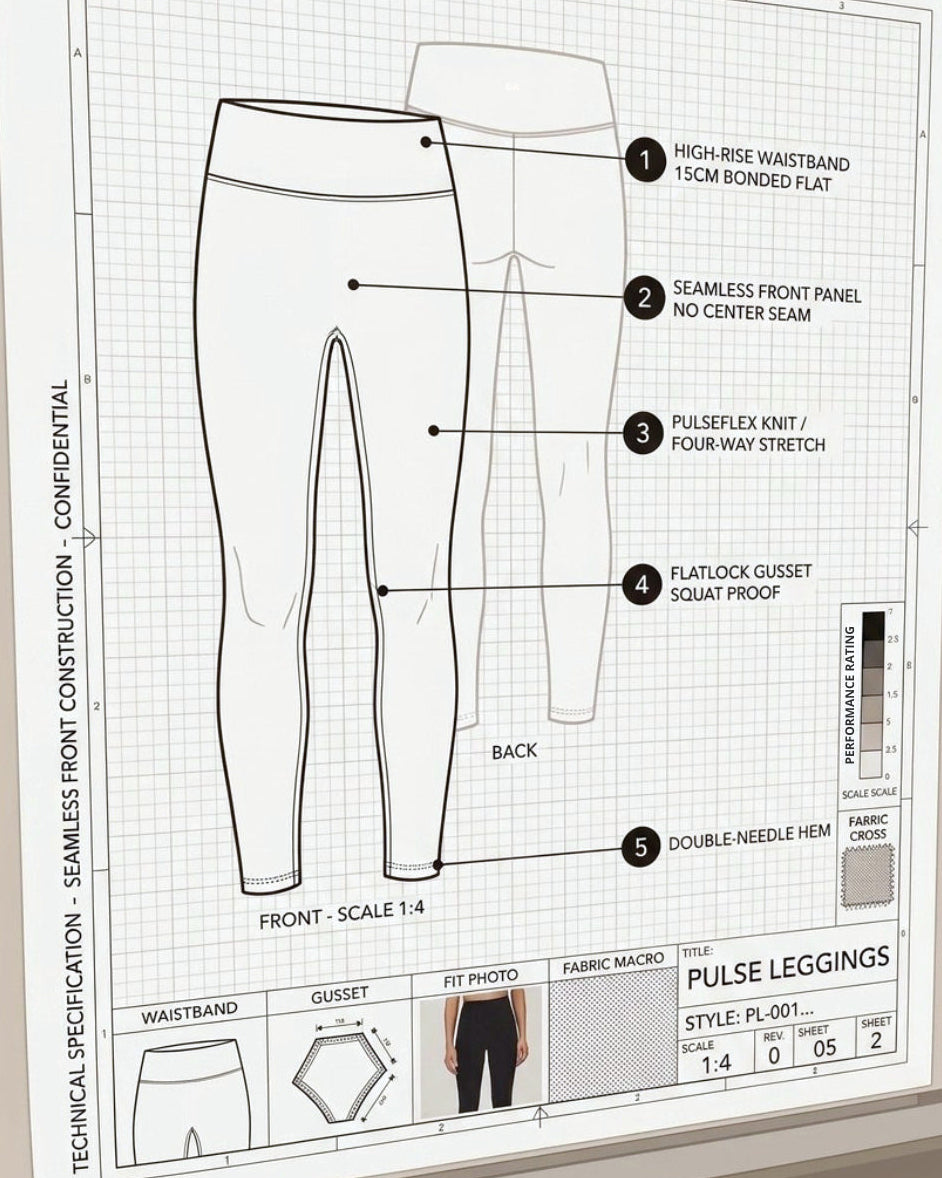
Designed in Stockholm: How Every Gymathlete Piece Is Actually Made
A mechanical watch and a pair of leggings have almost nothing in common, except for one thing: you cannot tell how either was made by looking at the outside. Two watches can look identical on a shelf while one is a movement assembled part by part and the other is a case with a battery in it. Activewear works exactly the same way, and the difference is just as invisible until you wear it.
Every Gymathlete piece starts as a sketch in our own studio in Stockholm. Never a ready-made product with our name added. Sample after sample, until there is nothing left to fix. This is what that actually looks like, including the time we designed a bag in Microsoft Paint because we did not know how to use anything else.

The Short Answer
Every piece we sell began as a drawing in our own studio and went through round after round of physical samples before it went on sale. Nothing is chosen from a supplier catalogue, printed with a logo and shipped out. It is slower, it is more expensive, and it is the entire reason the fit is what it is.
Why So Much Activewear Looks the Same
If you have ever noticed that a lot of activewear brands seem to sell suspiciously similar leggings, you are not imagining it. A large part of the industry runs on white-label and private-label manufacturing: a factory produces a stock design, dozens of brands order the same garment, and each one adds its own logo and its own story. The photography changes. The product does not.
There is nothing illegal about it, and for a brand it makes obvious sense. You skip the development entirely. No sketching, no pattern-making, no samples, no failed rounds, no cost. You pick from a catalogue and you are selling by the end of the month.
What you lose is every decision that makes a garment good. The rise of the waistband, the density of the fabric, where the seams fall, how the fit behaves when you actually squat in it: none of that is yours to control, because none of it was yours to design. You inherit somebody else’s compromises and hope your customers do not notice them.
It Starts With a Sketch
Ours start on paper. A shape, a proportion, a problem we want to solve, usually one we have been irritated by ourselves: a waistband that folds over mid-set, a fabric that turns translucent at the bottom of a squat, a strap that digs in when a bag is full.
From there it becomes a specification, then a pattern, then a first physical sample that almost never works. That is the part nobody photographs. The first sample exists to be wrong in specific, useful ways, so that the second one can be wrong in fewer.
It is the same logic as a movement being built on a bench. You are not assembling a finished thing; you are adjusting one small part at a time and testing what it does to everything else. Change the fabric weight and the fit changes. Move a seam and the stretch changes. Every part is connected, which is exactly why it cannot be ordered from a catalogue.

The Tote We Designed in Paint
The Balance Tote is the piece we are most attached to, and the least glamorous story we have.
When we started designing it, we had no real command of Adobe’s tools. Not a little rusty. We simply did not know how to use them. The professional route would have been to hire someone, or to pick something ready-made and move on. Instead we went back to basics: hand-drawn sketches, and then the shapes rebuilt in Microsoft Paint, because it was the tool we could actually operate.
It was slow and it looked ridiculous. It was also, in hindsight, the best thing that could have happened, because Paint forces you to think in the plainest possible terms. There are no clever effects to hide behind and no template to lean on. You have a shape, a proportion and a line, and if the proportions are wrong the drawing looks wrong immediately. You cannot dress it up.
So we drew it again. And again. Then came the physical samples, where the same questions returned in three dimensions: how long the handles needed to be to sit on a shoulder over a winter coat, how the base should hold its shape when the bag is full, how it should look when it is empty and folded on a hallway floor. Every one of those was a decision somebody made deliberately, in a room, arguing about it.
None of that shows up in the product photo. It shows up two years in, when the handles have not stretched out and the base still stands.
Sample After Sample, Until There Is Nothing Left to Fix
The rule we work to is simple: a piece is finished when we can no longer find a real reason to change it. Not when it is good enough, and not when the launch date says so.
In practice that means rounds of samples that get progressively more boring to look at. Early rounds change dramatically. Later rounds change by millimetres: a waistband a fraction taller, a seam moved slightly inward, a fabric swapped for one with better recovery so it holds its shape after a year rather than a season. From the outside the last three samples can look identical. They do not feel identical when you wear them.
This is the least efficient way to build a clothing brand, and we are aware of it. It is also the only way we know of to end up with something we would defend to someone’s face.
Why This Matters When You Buy
You are not paying for a sketch or a story. You are paying for what those rounds of samples produced, and it turns up in ways you can actually feel.
- Fit that was chosen, not inherited. The rise, the seam placement and the compression are ours, so when something does not work we change it rather than explain it away.
- Fabric selected for how it behaves over time. Recovery and density are decided at the development stage, which is what keeps a waistband holding and a fabric opaque after months of wear.
- Consistency between pieces. Because the same people make the same decisions across the range, a size behaves like that size across the collection.
- Things worth keeping. A garment that survives years rather than a season is the single most underrated part of buying better, which we break down in our guide on what leggings really cost.
If you want the concrete version of this, our guides on choosing leggings that do not go sheer and high-waisted leggings that stay up are essentially a list of the problems we spent our sample rounds solving.
Designed From Scratch, In Stockholm
The Pulse Leggings went through the same process: sketched, sampled, adjusted and adjusted again, until the waistband stayed put and the fabric stayed opaque. Cut from PulseFlex™, our own fabric, chosen for how it holds up rather than how it photographs.
Life is full of small discomforts. Your activewear shouldn’t be one of them.
Frequently Asked Questions
How can you tell if activewear is white-label or dropshipped?
Look for identical garments sold under several brand names, product descriptions that describe fabric only in vague terms, and a brand that cannot tell you anything about how a piece was developed. Brands that design their own products can usually talk about specific decisions, because they had to make them.
What does “designed in-house” actually mean?
That the design work itself happens at the brand: the sketching, the specification, the fit decisions and the sample rounds. It is different from simply choosing an existing product from a manufacturer’s catalogue and adding a logo.
Where is Gymathlete activewear designed?
Every piece is designed in our own studio in Stockholm, from the first sketch through every round of samples until the final version.
Why does it take so long to develop a piece of activewear?
Because each change affects everything else. Adjusting a fabric weight changes the fit, moving a seam changes how the garment stretches, and each round of physical samples has to be made, worn and assessed before the next one. Getting to a version with nothing left to fix takes several rounds.
Does designing your own products make them better?
It does not guarantee it, but it makes it possible. If you control the fit, the fabric and the construction, you can fix what does not work. If you bought a finished product from a catalogue, you can only choose a different one.